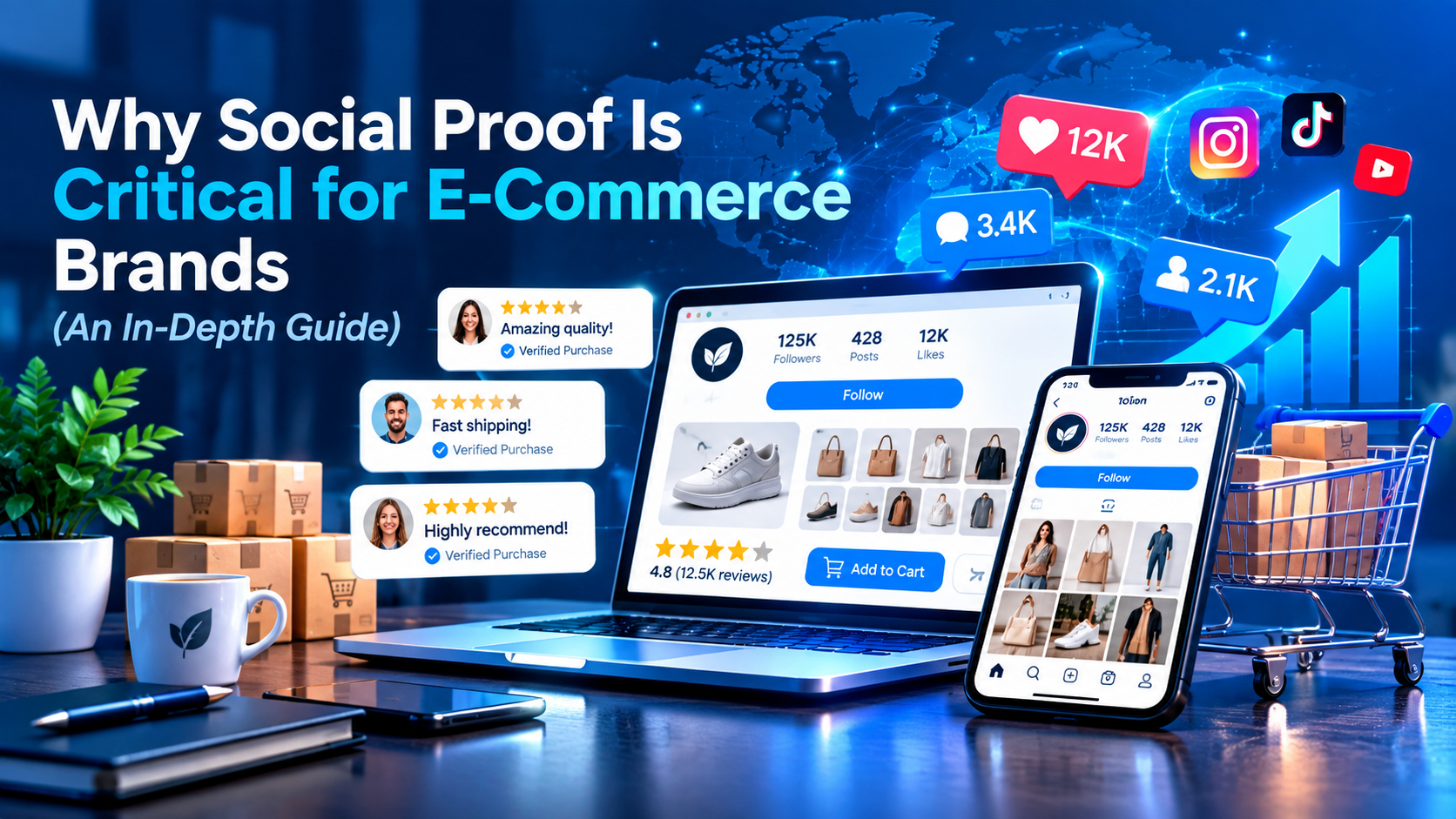
Why Social Proof Is Critical for E-Commerce Brands (An In-Depth Guide)
In today’s digital marketing ecosystem, competition is fiercer than ever. Thousands of new e-commerce stores launch every day, and social media platforms are flooded with brands competing for attention. As a result, modern consumers have developed a natural sense of skepticism and banner
blindness.
Having a high-quality product, fast shipping, or a sleek website design is no longer enough to secure sales. To get a potential customer to enter their payment details after clicking an ad, you need one critical element: Digital Trust.
Unlike traditional retail, online shoppers cannot touch a product, feel its fabric, or talk face-to-face with a salesperson. To make up for this gap, the human mind relies on psychological shortcuts to speed up decision-making. In marketing, this psychological mechanism is known as Social Proof.
1. Trust Perception in Online Retail: What Is Social Proof?
Social proof is one of the foundational principles of persuasion defined by psychologist Robert Cialdini in his seminal work, Influence: The Psychology of Persuasion. The theory states that when people are uncertain about how to act, what to buy, or how to fit in, they look to the actions of others to validate their choices.
The Crowd-Following Psychology and Your Digital Storefront
Consider a real-world example: You are looking for a place to eat in an unfamiliar city and come across two side-by-side restaurants.
- Restaurant A: Completely empty, with servers standing at the door waiting.
- Restaurant B: Packed with diners, with a line forming outside.
Even if logic suggests Restaurant B might be slower or more expensive, your subconscious immediately assumes that Restaurant B has better food, while Restaurant A must have a catch.
This exact dynamic plays out on e-commerce websites and social media profiles. When a user lands on your Instagram profile or storefront, your numbers—such as:
- Total follower count,
- Likes, saves, and shares on posts,
- Customer reviews and ratings,
- Video view counts,
create the exact impression of Restaurant B. High engagement metrics quietly reassure visitors that they are not alone and that thousands of others have already vetted your brand.
2. Marketing Psychology: How Many Times Must a Consumer See a Product Before Buying?
A long-standing principle in advertising, known as the Rule of 7, suggests that a prospect needs to encounter a brand’s message at least seven times before committing to a purchase. In the digital age, the frequency and impact of these touchpoints are shaped by key psychological phenomena.
The Mere-Exposure Effect and Illusory Truth
Discovered by psychologist Robert Zajonc, the Mere-Exposure Effect proves that people naturally develop a preference and trust for things simply because they are familiar with them.
The buyer journey typically moves through these stages:
- First Touch (Awareness): A user spots your ad or post. The brand name registers faintly in their mind.
- Second Touch (Recall): They see your brand again on an Explore feed or sponsored post. The brain recognizes the name with familiarity.
- Third and Fourth Touch (Trust): They repeatedly encounter your high-engagement profile and popular content. Familiarity matures into trust.
- Fifth Touch (Action): When the purchase intent strikes, the buyer skips unfamiliar competitors and chooses the brand they have seen over and over again.
The Bandwagon Effect
The Bandwagon Effect causes individuals to set aside their own hesitation and align with the majority. In e-commerce, seeing a product tagged as a "Best Seller" or visiting a page with tens of thousands of followers bypasses rational doubts. The buyer simply reasons that tens of thousands of people cannot all be wrong.
3. The 5-Second Rule and the Risk of Zero Engagement
The average internet user's attention span has dropped to just a few seconds. In digital marketing, the 5-Second Rule refers to the brief window a visitor takes to decide whether to stay on your profile or leave.
The "Abandoned Store" Effect of Low Metrics
You might offer an exceptional product, shoot high-end photography, and run a flawless website. But if a user clicks through to a social profile that shows:
- 150 Followers,
- 2 or 3 likes per post,
- Empty comment sections or posts from months ago,
it instantly creates the impression of an abandoned store or, worse, an unreliable business. The visitor immediately starts questioning:
- "Will my order actually ship?"
- "Can I reach customer support if there's an issue?"
- "Is this business even operational?"
The moment these doubts arise, bounce rates spike and ad dollars are wasted.
4. The Power of Influencers and Celebrities on Social Proof
Traditional television endorsements have evolved into influencer partnerships and creator collaborations. This shift is driven by Authority Bias and Social Transfer.
Leveraging Authority Bias for Industry Leadership
People naturally trust recommendations from figures they perceive as popular, expert, or authoritative.
- Micro vs. Macro Social Proof: When prominent creators or verified (blue check) accounts engage with your page, your brand moves from a generic e-commerce account to an industry leader.
- Consumers view interactions from recognized figures as a stamp of approval, lowering their hesitation to buy.
5. How Followers and Engagement Directly Drive Sales
Social media metrics are not just vanity figures. When managed strategically, they act as direct drivers of conversion rate optimization (CRO).
A strong foundation of social proof builds immediate trust with visitors. This trust reduces cart abandonment rates and significantly increases overall conversions and revenue.
- Higher Conversion Rates: Between two brands offering similar products at similar prices, the one with stronger social proof routinely converts visitors at 200% to 400% higher rates.
- Lower Customer Acquisition Costs (CAC): Strong social proof increases the return on ad spend (ROAS). Instead of converting 1 out of 100 ad clicks, a trusted profile can convert 3 or 4.
- Reduced Cart Abandonment: Nearly 70% of online shoppers abandon their carts prior to checkout, primarily due to last-minute hesitation or lack of trust. A solid social media presence eliminates that friction.
6. Driving Conversions via FOMO (Fear of Missing Out)
FOMO is one of the most compelling triggers in online shopping.
High view counts and engagement numbers create a sense of urgency:
- "This video has half a million views; stock might run out quickly."
- "Everyone is talking about this product; I don't want to miss out."
High-performing Reels and TikTok videos reinforce the idea that a product is trending, encouraging hesitant buyers to take immediate action.
7. The Perception of Verified Badges and Blue Checks
Verification badges across platforms serve as digital seals of authenticity.
- Accounts with verified status or high-prestige metrics are perceived as legitimate, legally compliant, and secure.
- Using verified or high-metric profiles in ad campaigns directly improves click-through rates (CTR) and overall campaign effectiveness.
8. Conversion Rate Optimization (CRO): Stop Wasting Your Ad Budget
When sales lag, business owners often assume the problem lies in their ad targeting or pricing. However, the bottleneck is usually a leaky conversion funnel.
If you spend your marketing budget bringing traffic to an account with low engagement, visitors bounce and ad spend goes to waste. Conversely, when paid traffic lands on a profile backed by strong social proof and balanced metrics, that traffic consistently converts into paying customers.
9. Natural Appearance and Balanced Metric Strategy
The biggest tactical mistake brands make when building social proof is using unbalanced or unrealistic metrics. An artificial-looking profile can cause more harm than a low-metric one.
The Golden Ratio of Engagement
For a profile to project genuine credibility, metrics must remain proportional:
- Follower-to-Like Ratio: If a page has 50,000 followers but receives only 5 likes per post, visitors will suspect artificial activity and trust disappears.
- Like-to-Comment Ratio: High-like posts should feature natural comments and customer inquiries.
- Views vs. Engagement: Video view counts on Reels or TikTok should scale logically alongside post likes and follower growth.
The optimal strategy involves scaling followers while simultaneously maintaining realistic likes, video views, and comments.
10. Accelerating Credibility with Social Media Marketing Solutions
Building social proof organically—reaching 10,000+ targeted followers and securing high engagement on every post—can take anywhere from 6 to 18 months. In fast-moving industries, time is a critical asset.
This is where working with a professional smm reseller provides strategic leverage:
- Day-One Authority: Instead of launching with zero presence, your brand enters the market with a established, high-engagement corporate image right out of the gate.
- Improved Advertising ROAS: Preparing your profile's metrics before launching paid ads maximizes the return on every dollar spent.
- Algorithm Boosts: High initial engagement signals to platform algorithms that your content is valuable, helping push posts onto organic Explore and Discover feeds.
Conclusion: Build Your Digital Trust Today
In e-commerce, product quality matters, but how you present and position that product dictates your sales numbers. Social proof is both your digital packaging and your most effective persuasion tool. The moment you signal to prospective buyers that thousands of others trust your brand, your sales performance moves upward.
To elevate your brand’s trust score, optimize your profile for ad campaigns, and scale your engagement metrics smoothly, explore our platform's comprehensive social media management solutions and packages. Strengthen your digital storefront today and stay ahead of the competition!
Frequently Asked Questions (FAQ)
1. Does social proof really impact e-commerce sales?
Yes. Studies consistently show that over 85% of online shoppers look for reviews, engagement metrics, and social proof before making a purchase from a new brand. Strong social proof directly increases conversion rates.
2. Should I grow my social media accounts before running ads?
Absolutely. Running ads with low-engagement accounts often leads to wasted ad spend because prospective buyers leave due to a lack of trust. Building metric depth beforehand ensures better ROI on ad campaigns.
3. Will using SMM services hurt my account?
Not when done using a balanced, natural approach. Maintaining proportional ratios between followers, likes, views, and comments keeps your profile looking organic while enhancing your brand's prestige.
4. Which social media metrics matter most for online stores?
While follower counts establish initial scale and credibility, post likes, video views, and active comments demonstrate that your brand is alive and popular. A balanced approach across all metrics yields the best results.
5. Is it safe to build social proof through SMM panels?
Using reliable platforms with automated order processing allows you to scale metrics safely without risking account security. Selecting the right service packages helps expand your brand image efficiently.