
Why "Post Everywhere" Is Bad Advice for Beginners
The usual advice is to film once and post everywhere. For a new account, that splits your attention three ways and leaves you with three dashboards that disagree about what actually worked.
The apps also judge videos differently. TikTok leans heavily on how strangers react, YouTube weighs search and whether viewers come back, and Instagram pays special attention to shares in DMs. Each one is better at a different job: getting found, building a library, or selling.
Short answer: Start on TikTok if you have no audience and want feedback fast. Pick YouTube Shorts if you want videos that keep earning views months later and you might move into longer content. Choose Instagram Reels if you sell something or already have followers there.
The Core Difference at a Glance
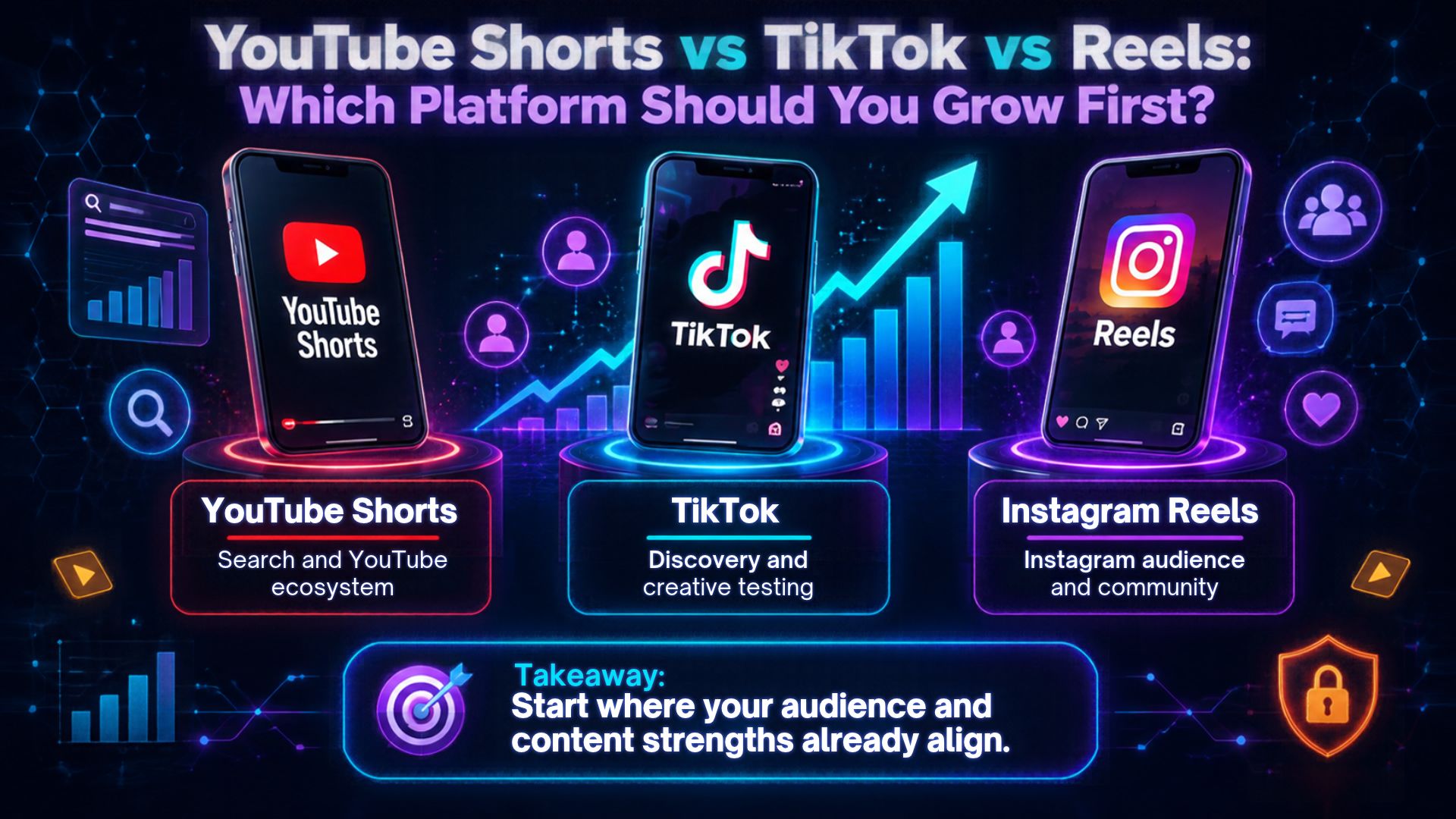
TikTok wins on speed, Shorts on staying power, and Reels on turning viewers into customers. The table shows where each one stands before we get into the details.
- Discovery speed for a new account: TikTok usually gives new accounts the fastest feedback. Shorts and Reels reach non followers too, but new accounts tend to build more slowly there.
- How long a video keeps getting views: on TikTok and Reels most views tend to arrive in the first days, though some posts resurface later; on Shorts, search and suggestions can keep a video going for months.
- Why people open the app: to be entertained on TikTok, to learn or look something up on YouTube, and to keep up with people and brands they follow on Instagram.
- Audience age: TikTok skews youngest, YouTube has the widest range, and Instagram leans toward young adults and up.
- Content that fits best: trends, personality and quick reactions on TikTok; tutorials, explainers and evergreen topics on Shorts; lifestyle, products and behind the scenes on Reels.
- Maximum length: TikTok allows 10 minutes recorded in the app and up to 60 minutes uploaded. Shorts and Reels allow 3 minutes for most accounts.
- Direct payouts: TikTok has Creator Rewards for videos over one minute, YouTube shares the Shorts ad pool, and Instagram has no open per view program.
- Strongest conversion path: TikTok Shop and affiliate links on TikTok, subscribers who move on to long videos on YouTube, and DMs, bio links and Stories on Instagram.
Length limits come from YouTube's and TikTok's own documentation (see Sources at the end). Instagram is still rolling out longer uploads to some accounts, so check your own app before planning anything over three minutes.
1. TikTok: The Fastest Engine for Zero to One Discovery
How the algorithm treats new accounts
TikTok often shows a new video to a small group of viewers first, many of whom don't follow you. When they watch to the end, replay it, comment or share, the video tends to reach more people. Follower count matters less here than on the other two apps.
That's why a week old account can land 100,000 views while an account with 50,000 followers gets 600 on a weak post. For a beginner, the real prize is the speed of the verdict: you find out within a day or two whether an idea works. Our TikTok views guide goes deeper into the retention side of this.
Content style and pacing
The videos that travel on TikTok feel like someone talking to you, not presenting to you. Think direct to camera, a strong opinion in the first line, quick cuts, and text on screen from the very first frame.
Polish matters less here than anywhere else. A phone video shot in a kitchen with a clear point of view will usually beat a well lit clip that says nothing new. Trends help too, but only while they're still climbing; jumping on a sound two weeks late rarely pays off.
The catch: a short shelf life
Many TikTok videos get most of their views in the first few days. Some come back later through TikTok search or a revived trend, but you can't plan around that. Growth here depends on steady output: post three times a week for a month, disappear for three weeks, and the account usually cools off.
Set a pace you can hold for 90 days, not one you can hold for two weeks.
Where the money really comes from
TikTok does pay for views, but only on longer videos and only after you clear a fairly high bar (the full requirements are in the monetization section below). For most small and mid sized creators, the bigger income comes from TikTok Shop affiliate commissions, LIVE gifts and brand deals, all of which can start well before view payouts do.
2. YouTube Shorts: Long Term Search Traffic and Evergreen Growth
Why a Short can still pull views months later
YouTube is a feed, but it's also where a lot of people go when they want to learn how to do something. A Short called "how to clean white sneakers" can turn up next spring when someone types that exact phrase, on YouTube and sometimes on Google too.
Suggested videos and your channel page add slow, steady traffic on top. TikTok and Instagram posts can resurface too, but YouTube's search habit makes it far more likely that an upload from last spring is still bringing in viewers today.
Optimizing Shorts for search
Since search is the advantage, treat every Short a little like a blog post:
- Title: use the words people actually type. "3 mistakes when repotting a monstera" will be found; "my plant fail" won't.
- First line spoken: say the topic out loud in the opening seconds. It confirms to the viewer they're in the right place, and auto captions give YouTube one more clue about what the video covers.
- Description: one or two plain sentences that repeat the main phrase. No hashtag walls.
- Thumbnail frame: Shorts thumbnails appear in search results and on your channel grid, so pick a frame that still reads at the size of a postage stamp.
The bridge to long form content
On YouTube, the person who watched your 40 second Short is one tap away from your 12 minute video, your live stream and your community posts. They're also the same subscriber in all of those places.
That's the quiet strength of Shorts. A follower on TikTok or Instagram mostly stays a short form viewer, while a YouTube subscriber can grow into someone who watches you for an hour a week.
How Shorts pay
Shorts earn from a shared ad pool rather than from ads placed on your own video, and the entry rules change in February 2027. Both are covered in the monetization section below.
The catch: slower initial traction
Many new channels see their first Shorts stall at a few hundred views. YouTube doesn't publish why, but the common pattern is that it needs a handful of uploads to work out who your viewers are.
The practical fix is to stick to one topic for your first few weeks. A channel that jumps from cooking to gaming to fitness gives YouTube, and viewers, very little to go on.
3. Instagram Reels: The Best Platform for Trust, Branding, and Sales
Sends and saves count more than raw watch time
Instagram's head, Adam Mosseri, has named watch time, likes and sends as the three signals that matter most, and he's been specific about the split: likes weigh slightly more with your followers, sends slightly more with people who don't follow you yet. A "send" is someone sharing your Reel to a friend in DMs.
In practice, the Reels that grow accounts are the ones people forward with a message like "this is so you" or "we need to try this." Before you post, ask yourself who a viewer would send it to. If you can't picture anyone, rework the idea.
The ecosystem advantage
No other app gives a viewer this many small steps toward buying from you. A typical path looks like this:
Reel → profile → Stories and Highlights → link in bio or a DM
Picture a small candle brand. A Reel showing the pour gets someone to the profile, Highlights answer "how long does it burn?", and a comment like "send me the scent list" turns into a DM conversation. Instagram's tools for automated DM replies make that last step easy to run at scale.
Audience buying power
People on Instagram already expect to see products in their feed, and plenty of them have bought something because of a Reel. For e commerce stores, coaches and service businesses, that habit is worth more than raw reach. We explain why reviews, follower counts and visible engagement shape those purchases in our guide to social proof for e commerce brands.
The catch: the hardest cold start
Reels do reach non followers, but a brand new account usually grows slower here than on TikTok, since Instagram has little history to judge you by. One useful workaround: Trial Reels, available on professional accounts, show a Reel only to non followers first, and you can see how it did before deciding whether to share it with everyone.
Use trials to test hooks and formats. Then post the winners normally.
How Much Can You Actually Earn? Monetization Compared
YouTube is the only one of the three with an open, published ad revenue share for short videos. TikTok pays per view only on originals longer than a minute, and Instagram has no standard per view program at all.
- TikTok Creator Rewards (formerly the Creator Fund): you need to be 18+, have 10,000 followers and 100,000 views in the last 30 days, and live in an eligible country. You're paid on qualified views of original videos over one minute.
- YouTube fan funding (first tier): 500 subscribers and 3 public uploads in 90 days, plus either 3,000 watch hours in 12 months or 3 million Shorts views in 90 days. This unlocks channel memberships, Super Thanks, Super Chat and Shopping.
- YouTube Partner Program (full): 1,000 subscribers, plus either 4,000 watch hours in 12 months or 10 million Shorts views in 90 days. This unlocks ad revenue; on Shorts you keep 45% of what's allocated to you from a shared pool.
- Instagram: there's no public threshold for per view pay. Money comes from Subscriptions, gifts, invite only bonuses and brand deals.
TikTok figures follow TikTok's Creator Academy requirements; YouTube figures come from YouTube's Shorts monetization policies and its August 2026 announcement (see Sources at the end).
The February 2027 change every Shorts creator should know about
YouTube announced in August 2026 that from February 1, 2027, new applicants to the full Partner Program will still need 1,000 subscribers, plus either 8,000 watch hours over 365 days or 20 million Shorts views over 90 days. That's double today's bar on both routes.
A separate rule applies to channels already earning from Shorts. To receive Shorts ad revenue in a given month, a channel will need at least 10 million qualified Shorts views over the trailing 90 days. Dropping below that doesn't remove you from the program or touch your long form earnings; Shorts payouts simply resume once you're back over the line. The fan funding tier is unchanged, so memberships and Super Thanks stay within reach of much smaller channels.
Payout myths most creators believe
- "One viral video and I'm set." Shorts revenue is split across every monetizing creator by share of engaged views, and a Short that uses licensed music sends part of its revenue to rights holders first. A million views often pays far less than people expect, and it varies by viewer country.
- "TikTok pays for every video I post." Only original videos over one minute count toward Creator Rewards. A 20 second trend clip earns nothing directly, however well it does.
- "Platform payouts are the main income." For most accounts under a few hundred thousand followers, products, affiliate links and sponsorships bring in more. Our breakdown of five ways to make money on social media covers the options that start paying earlier.
Head to Head: Which Platform Wins Each Category?
No platform wins everything. Here's who takes each category, and the reason that tips it.
Easiest to go viral from zero: TikTok. Beyond the test group system, Stitch and Duet let a brand new account borrow attention from a video that's already blowing up. A sharp reply to a trending post can outperform anything you'd film from scratch.
Best for a loyal community: Instagram Reels. Comments on Reels lead into DMs, Close Friends Stories, broadcast channels and polls. People feel like they know you, and that closeness is what makes them buy, recommend and stick around. YouTube comes a close second for depth, since long videos build a different kind of loyalty.
Best for direct ad revenue: YouTube Shorts. It's the only one with an open revenue share and published rules. Even with the 2027 changes, the path is clearer than anywhere else.
Best for selling products or services: split decision. Reels win for services and considered purchases, where buyers want to look around your profile before reaching out. TikTok Shop wins for cheaper impulse products a viewer can buy without leaving the video.
Best for faceless content: YouTube Shorts. Narrated explainers, screen recordings, how to clips and "top 5" formats get found through search without you ever appearing on camera. TikTok rewards personality so heavily that faceless accounts have a harder time there. One warning: YouTube doesn't pay for reused or non original Shorts, so stitched together clips of other people's content won't earn.
Best for live streaming: TikTok LIVE. Streams can surface in the For You feed, which puts you in front of strangers in real time. YouTube Live is better for long sessions and replays that keep getting watched afterward. For audience building tactics on both, see our guide to growing a live stream audience.
Best analytics for learning what works: YouTube Shorts. YouTube Studio shows a second by second retention graph, where viewers came from, and even the search terms that found you. You can see the exact moment people swiped away and fix it in the next upload.
What It Really Costs You: Time and Production Effort
TikTok asks for the most videos, Reels for the most polish, and Shorts sit in between. These are starting points we suggest for a solo creator, not official numbers; adjust them once you have a month of your own data.
- TikTok: 20–45 seconds is a good starting length, or over 60 seconds if you're aiming for Creator Rewards. A realistic pace is 4–7 videos a week, and editing effort is low to medium: on screen text and native sounds do most of the work.
- YouTube Shorts: start with 30–60 seconds and 3–5 videos a week. Editing effort is medium, mostly because the title and thumbnail frame need thought.
- Instagram Reels: start with 15–30 seconds and 3–4 Reels a week, plus Stories on most days. Editing effort is medium to high: cover image, captions and a consistent look all matter.
The hidden cost is ideas, not editing. Most people who burn out didn't run out of time to cut videos; they ran out of things to say on a Tuesday night. Keep a running list of questions your audience asks, and spend one hour a week turning it into five scripts before you film anything.
AI Generated Content: What Each Platform Allows
All three let you use AI, but all three want a label when the result looks real. The rule of thumb is simple: if a viewer could mistake it for a real person, place or event, disclose it.
- TikTok: requires a label on AI generated content showing realistic images, audio or video. You turn on "AI generated content" under More options before posting, and TikTok says the label won't hurt distribution as long as the video follows its guidelines. Unlabeled realistic AI content can be removed. AI written scripts and captions don't need a label.
- YouTube: asks at upload whether the video contains realistic altered or synthetic content. Beauty filters and small edits don't count. Separately, mass produced videos built from generic AI templates aren't eligible to earn money.
- Instagram: shows an "AI info" label on photorealistic AI content, and can apply it automatically when a file carries AI metadata.
These summaries are based on each platform's published guidance (see Sources at the end). The policies change often, so check each app's help center before a campaign.
How to Choose: 5 Questions to Ask Yourself
Answer these honestly and the choice usually makes itself.
- What do you want in six months: an audience, income, or customers? An audience points to TikTok, steady income to YouTube, customers to Instagram.
- How many videos can you really make each week? Under three, and TikTok will feel like a treadmill. Shorts forgive a slower pace because old uploads keep working.
- Do you have something to sell right now? If yes, the shortest path from video to checkout matters more than reach.
- Are you comfortable on camera? If not, lean toward Shorts, where voiceovers and screen recordings hold up well.
- Do you plan to make longer videos one day? If yes, start building subscribers on YouTube now rather than moving an audience over later.
The "Start With One, Repurpose Later" Framework
Pick one primary platform, give it your full attention for a month, then feed its best videos to a second app. That way you learn one algorithm properly instead of three badly.
Choosing your secondary platform
Your second platform should cover the main weakness of your first:
- TikTok first, then YouTube Shorts: your best clips get a second life in search instead of fading after a week.
- Instagram Reels first, then TikTok: you reach strangers faster while Instagram handles the selling.
- YouTube Shorts first, then Instagram Reels: you add a place where viewers can message you and buy.
One video, three hooks
The same video lands differently on each app because people arrive in a different mood. Keep the body of the video and rewrite only the first line. Here's one video about flat sourdough, opened three ways:
- TikTok: "You're killing your starter and you don't even know it." (A bold claim that stops the scroll.)
- Reels: Open on the finished loaf being sliced, then: "Three changes that got me this crumb." (A result worth saving and sending.)
- Shorts: "Sourdough not rising? Here's why." (The words someone would type into search.)
Cross posting without losing reach
- Export the clean file from your editor. Never download a TikTok with its watermark and upload it to Reels or Shorts.
- Add text, captions and stickers inside each app rather than burning them in once for all three.
- Write a new caption for each platform. A TikTok caption full of hashtags looks out of place on YouTube.
- Space uploads a few hours apart, so you can tweak the next version if the first one underperforms.
Music and copyright pitfalls
A sound you picked from TikTok's library is licensed for TikTok, not for YouTube or Instagram. Re add audio from each app's own library, or use royalty free tracks that are cleared for Content ID.
YouTube is the strictest here. A Short longer than one minute with any active Content ID claim is blocked worldwide, not just demonetized. If a Short uses commercial music, keep it under 60 seconds.
A simple 90 day roadmap
Days 1–30: post on your primary platform only, at the pace you set. Track average watch time and the retention curve, and note which hooks keep people past the first few seconds. Ignore follower count for now; it lags behind everything else.
Days 31–60: keep the primary going and repurpose your top 20% to the secondary. Judge the new app by shares and saves rather than views. The same number means different things in each place, so on Instagram watch sends, and on YouTube watch how many Shorts viewers go on to visit your channel.
Days 61–90: compare profile visits, follower conversion (new followers per 1,000 views) and, if you sell something, website clicks and DMs on both platforms. These show which app turns attention into something you can use, and that's where your time should go next quarter.
Common Mistakes That Kill Growth on All Three Platforms
Wasting the first two seconds
Most creators open with a greeting, a logo or a slow pan. By the time the point arrives, the viewer is two videos further down the feed. Start in the middle of the action, and put a line of text on screen that tells people why they should stay.
Chasing views instead of retention and shares
A view count tells you how many people saw the first frame. It says nothing about whether they cared. Watch two ratios instead: the average percentage of the video people watched, and shares per 1,000 views. A video with 8,000 views and strong sharing is a better template for your next post than one with 40,000 views that everyone abandoned halfway through.
Letting a good video die with zero early engagement
A good video with no likes or comments in its first hours looks unproven, to viewers and probably to the app as well. Nobody outside the platforms knows exactly how much those early reactions weigh, so treat them as feedback rather than a switch you can flip. The lever you fully control is distribution: share every new post to your Stories, community tab or email list so real viewers see it first.
Visible numbers also shape first impressions. A new profile with three likes per post can look abandoned, and plenty of creators and brands use growth services to get past that stage; we look at how common this is in the truth behind the organic growth myth. Just don't confuse bought numbers with real interest. They won't make a weak video spread or replace real viewers, and TikTok, Instagram and YouTube all prohibit fake engagement, so accounts that lean on it risk removed interactions or limited reach. Lasting growth still comes from videos people actually want to watch and share.
Ignoring account security until it's too late
As soon as an account starts growing, the fake "copyright violation" DMs and too good to be true brand deals show up. One click on the wrong link can cost you the account. Turn on app based two factor authentication on all three platforms today, and read our guide to protecting your social media accounts before your first big video, not after.
Final Verdict: Which Platform Should You Start With?
New creator with no audience: start on TikTok. You'll learn faster there than anywhere else, and your strongest clips can move to Shorts from day 31.
Brand or online store: start on Instagram Reels, where browsing turns into buying, and add TikTok in month two to reach new customers.
Educator, expert or faceless channel: start on YouTube Shorts. Your videos keep working through search, and you're building toward long form and the Partner Program on the same channel.
Agency or SMM reseller: your clients will ask about all three, so run your own account on the platform they buy for most and learn it from the inside. If you're setting up that side of the business, our SMM reseller guide walks through the setup.
Whichever you choose, give it 90 days before judging it. Most accounts that "didn't work" were abandoned in week three.
Your next step: pick one platform today and start the first 30 days of the roadmap above. If you help clients grow on these apps, or want to turn it into a business, our guide to SMM resellers vs providers shows which model fits you, and you can open a ResellerSMM account whenever you're ready to start.
Frequently Asked Questions
Instagram Reels vs TikTok: Which Is Better?
It depends on what you need from the app. TikTok is better for reaching people who've never heard of you, especially with a brand new account. Reels are better once you want those viewers to trust you, message you and buy. If you're building an audience from zero, start with TikTok; if you're selling a product or service, Reels usually earn more per viewer.
Can I grow on TikTok, YouTube Shorts and Instagram at the same time?
You can, but it's hard to do well from day one. Running three accounts at once usually means thinner videos and slower learning. Most creators get further by building one platform for a month or two, then repurposing their best clips to the others once they know what works.
Is YouTube Shorts better than TikTok for beginners?
For fast feedback, no: TikTok tells you within days whether an idea works. For a channel you want to still be getting views from next year, Shorts is the better long term bet. Many beginners start on TikTok to learn and add Shorts once they know what their audience responds to.
How much does TikTok pay?
TikTok doesn't publish a fixed rate. Through Creator Rewards (formerly the Creator Fund), you earn on qualified views of original videos longer than one minute, and the rate per 1,000 views shifts with your niche, your viewers' countries and how long they watch. Most creators make more from TikTok Shop commissions, LIVE gifts and brand deals than from views.
How much does YouTube Shorts pay?
There's no set price per view here either. Ad revenue from the Shorts feed goes into a monthly pool, each channel gets a slice based on its share of engaged views, and the creator keeps 45% of that slice. Earnings per million views are modest and depend heavily on where your viewers live. From February 1, 2027, a channel also needs 10 million qualified Shorts views every 90 days to keep earning Shorts ad revenue.
Does Instagram pay for Reels?
Not per view, for most accounts. Instagram has run invite only bonus programs, and eligible creators can earn through Subscriptions, gifts and brand partnerships, but there's no open program that pays a set amount for views.
How often should I post on TikTok?
Four to seven videos a week is a solid starting range for a new account. If daily posting drags your quality down, three strong videos a week will do better than seven rushed ones. Hold a steady rhythm for at least a month before judging the results.
Can I post the same video on TikTok, Reels and Shorts?
Yes, as long as you upload a clean file without another app's watermark, re add the audio from each app's library, and write a new caption. Changing the opening line for each audience makes an even bigger difference.
What if a video works on one platform but flops on another?
That's normal and useful. It usually means the topic is fine but the opening didn't match how people use the second app. Try a new hook and cover on the weaker platform before you drop the idea.
Which platform is best for faceless content?
YouTube Shorts. Search driven topics like tutorials and explainers do well with a voiceover or screen recording. Just make sure the content is your own, since YouTube doesn't pay for reused clips.
How long does it take to grow on each platform?
There's no fixed timeline, but the shape differs. TikTok tends to give quick spikes early, Shorts often starts slow and builds steadily, and Reels grow fastest once you have some followers who share your posts.
Which platform is best for selling products?
Instagram Reels for higher priced products and services, where buyers want to check your profile and message you first. TikTok Shop for low cost items people will buy straight from the video.
Sources
- YouTube Help: Shorts monetization policies
- YouTube Help: Understand three minute YouTube Shorts
- Tubefilter: YouTube's stricter Shorts ad eligibility (Aug 2026)
- Switcher Studio: TikTok Creator Rewards requirements
- Social Media Today: Mosseri on Instagram's top ranking signals
- Engadget: Instagram trial Reels for non followers
- Kapwing: When should you label videos as AI?
- Postfast: TikTok video specifications
In this guide:
- The core difference at a glance
- TikTok: fastest discovery
- YouTube Shorts: long term search traffic
- Instagram Reels: trust and sales
- How much you can earn
- Which platform wins each category
- Time and production effort
- AI generated content rules
- 5 questions to ask yourself
- Start with one, repurpose later
- Common mistakes
- Final verdict
- FAQ